
Written by Alex, Production Engineer at EAST AI
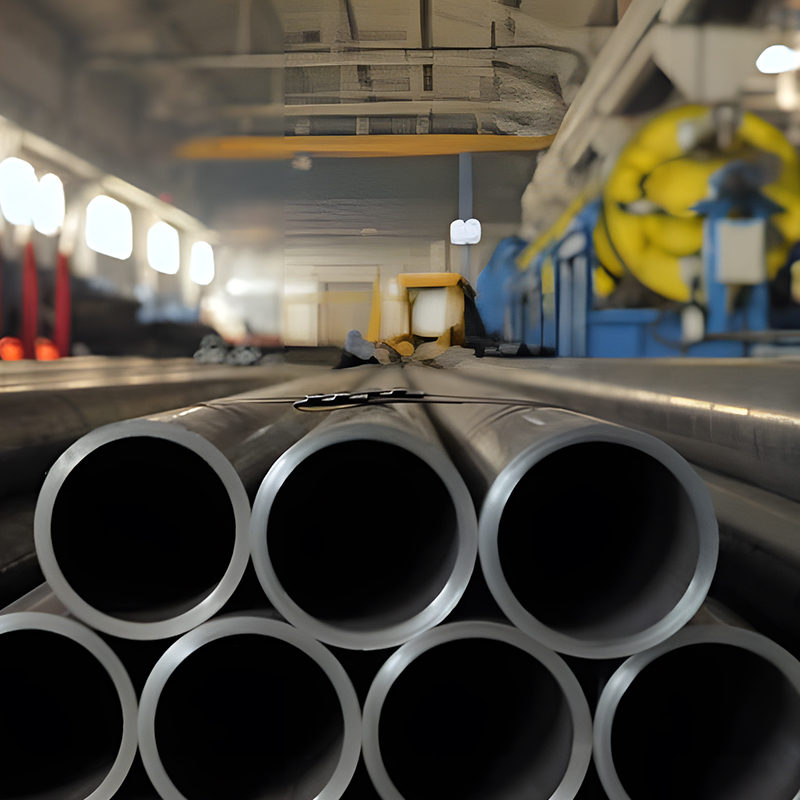
The first thing that strikes you on a construction site is how brutally the hydraulics are treated compared with almost any factory environment. An excavator boom cylinder takes shock loads every time the bucket bites into rock, the rods and tubes are coated in abrasive dust and slurry, and the machine works long shifts through temperature swings that a climate-controlled factory never sees. When a customer building excavator and loader cylinders comes to us for honed tube, the conversation is never just about bore size and finish, because the construction environment punishes any tube that was specified as though it would live an easy indoor life.
Construction machinery is one of the largest and most demanding markets for hydraulic cylinders, and the honed tube inside those cylinders has to survive conditions that expose every weakness in material selection, wall thickness, and geometry. Getting the tube specification right is what separates a cylinder that runs for years of hard duty from one that scores its bore, leaks past the seal, and comes back as a warranty claim. The requirements are specific enough that they deserve to be understood in their own right rather than borrowed from lighter industrial applications.
Shock Loading Changes the Wall Thickness Conversation
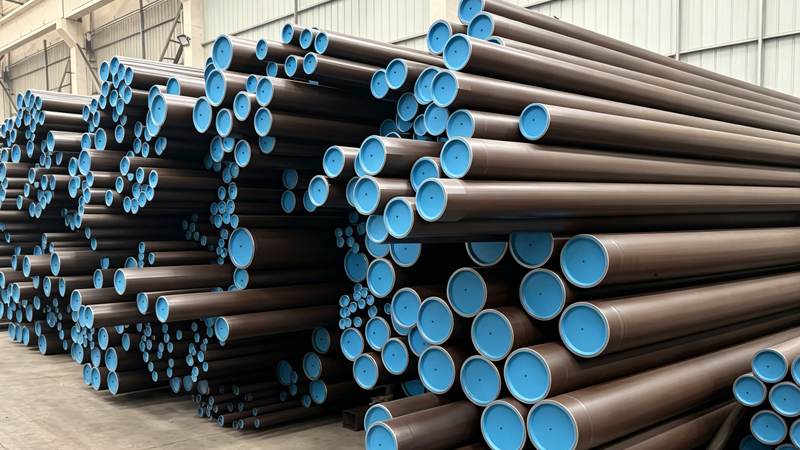
A construction cylinder rarely sees a smooth, predictable pressure profile, because the work itself is full of impact. When a bucket strikes rock, when a loader arm slams into a pile, or when a boom is stopped abruptly at the end of its stroke, the cylinder experiences pressure spikes well above its nominal working pressure, and those transient spikes are what actually govern the wall thickness the tube needs. Sizing the wall for the nominal pressure alone is a mistake, because the real load case is defined by the peaks, not the average.
This is why we size honed tube wall thickness for construction applications with meaningful margin above the calculated minimum for the nominal pressure. The tube has to absorb repeated pressure excursions without yielding or fatiguing, and it has to do so over millions of cycles across a long service life, so the conservative wall is not padding but engineering. A tube that is adequate for a smooth industrial press can be dangerously marginal in an excavator, and understanding that difference is the starting point for any honest construction cylinder specification.
Straightness and Side Loading in the Field
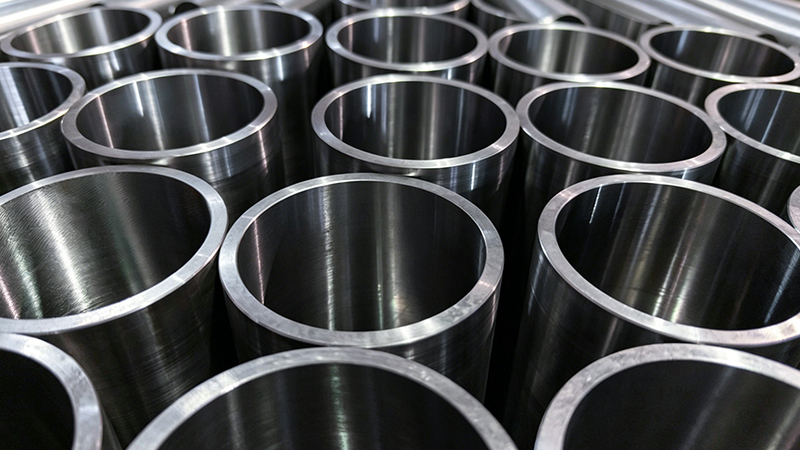
Construction cylinders are frequently subjected to side loading that a textbook design would prefer to avoid, because the geometry of a working machine simply cannot keep every load perfectly axial. A boom cylinder carries bending as the arm swings, a steering cylinder fights uneven ground, and the linkages transmit forces that are never purely along the cylinder axis. That side loading means the straightness of the honed tube bore matters far more than it would in a clean, well-guided application, because a bore that wanders from true concentrates the side load unevenly against the seal and the piston.
We control honed tube straightness to around 0.5 millimeters per meter for exactly this reason, because a straight bore keeps the piston and seal running evenly even when the external loading is trying to push them off axis. Combined with a bore held to H8 or H9 tolerance, that straightness gives the seal package the consistent geometry it needs to survive the side loads that construction duty inevitably imposes. When straightness is neglected, the symptom shows up as uneven seal wear and premature leakage, and it is usually misdiagnosed as a seal problem when it was really a tube geometry problem all along.
Contamination Is the Constant Enemy
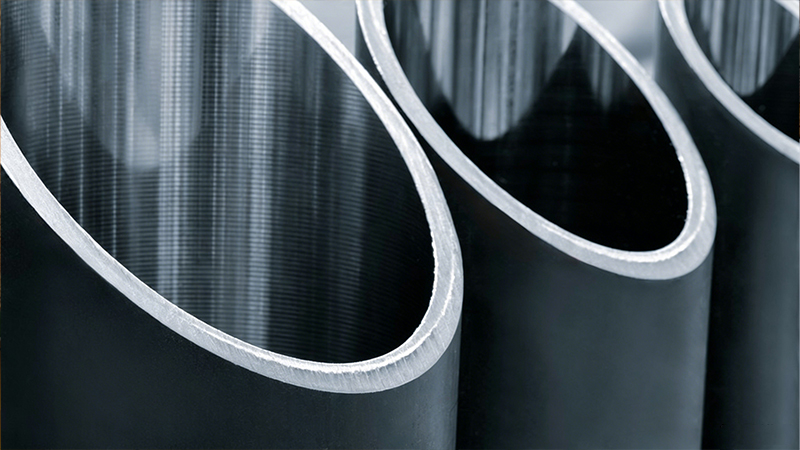
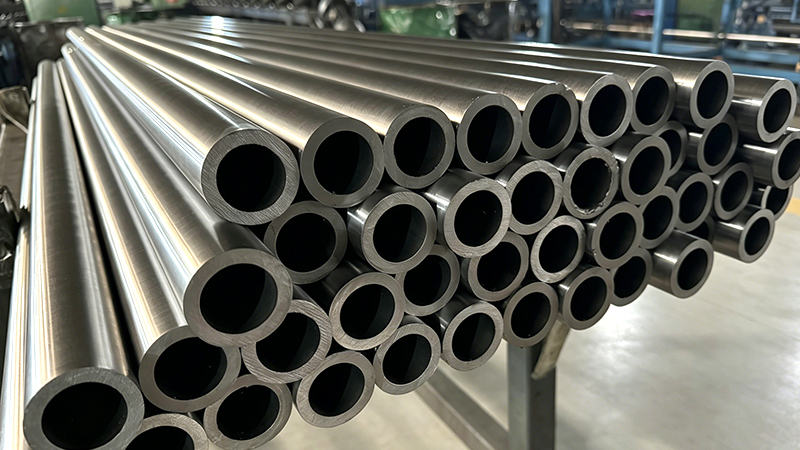
Nothing tests a cylinder bore like the dust, grit, and moisture of a construction site, all of which are working to get past the seal and score the bore. The honed cross-hatch finish on the bore is part of the defense, because the pattern retains a lubricating oil film that keeps the seal and piston separated from the metal and helps flush fine particles rather than letting them embed. A bore finished to the correct Ra 0.4 to 0.8 micron range with a proper cross-hatch holds that film far better than a bore that is either too rough or polished too smooth.
The base steel and its condition also matter here, because a harder, more consistent bore surface resists the scoring that abrasive contamination causes. Material selection for construction honed tube leans toward steels that offer good strength and a bore that can take punishment, whether that is a well-controlled ST52 for welded constructions or a higher-strength grade where the design allows. The goal throughout is a bore that keeps the seal sealing and the contamination out, because on a construction site the contamination never stops trying to get in.
Duty Cycle and Thermal Reality
Construction machines work hard for long shifts, and the honed tube has to tolerate a duty cycle and a thermal environment that are both more severe than most industrial equipment. The oil heats up over a working day, the machine may start cold on a winter morning, and the cylinder cycles far more often than a comparable factory actuator. All of this feeds back into material and dimensional choices, because a tube that is dimensionally stable across temperature and fatigue-resistant across millions of cycles is what keeps the cylinder performing from the first shift to the last.
This is also where honest supply matters, because a construction cylinder builder is making a promise to a machine operator who cannot afford downtime in the field. A tube that meets its specification on paper but was cut from an inconsistent batch, or finished to a nominal number without regard for the real duty, becomes a field failure that damages the builder’s reputation as much as the end user’s uptime. Matching the honed tube to the true construction duty cycle, rather than to a generic industrial baseline, is the difference between a cylinder that earns repeat orders and one that generates warranty claims.
Specifying Construction Honed Tube Properly
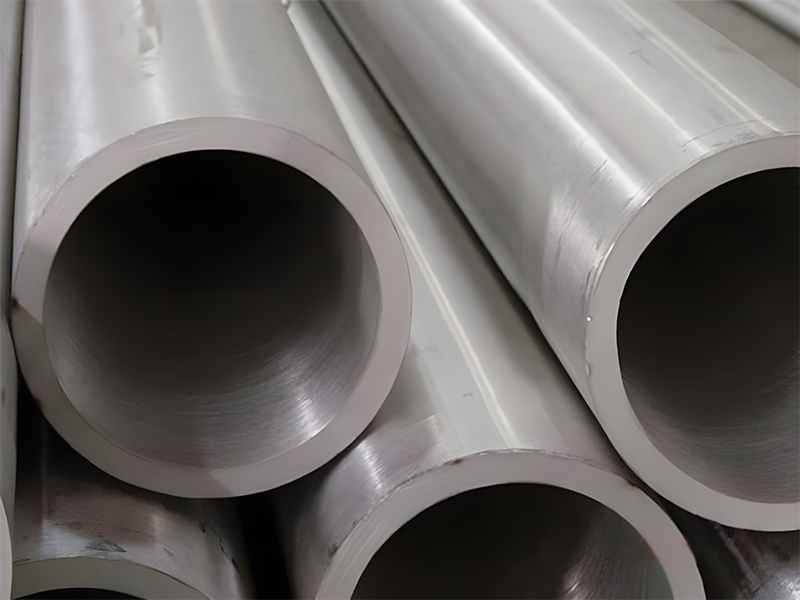
The right way to specify honed tube for a construction cylinder is to describe the real duty first and let the tube follow from it. State the working pressure and the expected shock spikes, describe the side loading the geometry imposes, be honest about the contamination and thermal environment, and then let the wall thickness, material, straightness, and finish be engineered to that reality. A tube specified this way costs a little more than a generic one and lasts a great deal longer, which is exactly the trade a serious cylinder builder wants to make.
The alternative, specifying by copying a lighter application or by minimizing every parameter to hit a price, is a false economy that construction duty punishes quickly and visibly. We have supplied honed tube into excavator, loader, and other construction cylinder programs long enough to know which corners cannot be cut, and the conversation we would rather have is the one about real operating conditions before the tube is made. That is how a construction cylinder ends up matched to the work it will actually do, rather than to the work someone hoped it would do.
Related Reading
- Hydraulic Cylinders for Construction Machinery
- Honed Tube for Agricultural Machinery Cylinders: Handling Dust, Moisture and Field Duty Cycles
- Honed Tube Product Range
Build Construction Cylinders That Survive the Field
A construction cylinder does not fail politely; it fails on a job site, on a machine that costs money for every hour it sits idle, and the root cause is often a honed tube that was specified for an easier life than it got. At EAST AI we have supplied honed tube into excavator, loader and heavy-equipment cylinder programs for years, and we specify wall, material, straightness and finish to the real shock, contamination and duty cycle your machines face, not to a generic baseline.
What We Offer
- Honed tube with conservative wall thickness sized for real construction pressure spikes
- Straightness controlled to 0.5 mm/1000 mm for side-loaded boom and arm cylinders
- H8 / H9 bore tolerance with Ra 0.4–0.8 μm cross-hatch finish for contamination resistance
- Material selection matched to welded or tie-rod construction and heavy-duty cycles