
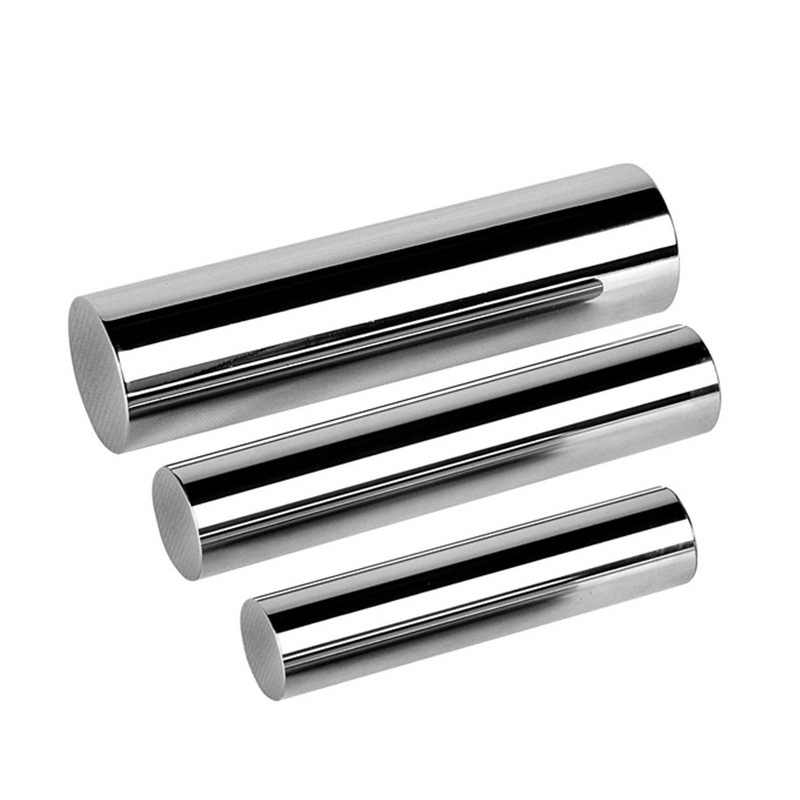
A service provider sourcing chrome plated rod on behalf of a customer almost always has the same instinct when a specification is ambiguous: choose the more conservative option. Harder steel, thicker plating, tighter tolerance. The logic feels sound — a more capable part is a safer recommendation, and if the customer never complains, the extra cost disappears into the BOM without notice. The problem with this logic is that “the customer never complains” is not evidence that the specification was right. It’s evidence that the part didn’t fail — which is true of almost every specification with meaningful margin, whether that margin is two percent or two hundred percent.
Over-specification in chrome plated rod is one of the most consistent sources of unnecessary cost in the supply chain for hydraulic components, and it’s disproportionately common among service providers who are recommending specifications rather than engineering them, because the cost of over-specification is invisible while the cost of a field failure is very visible.
Published: 2026-10-29 | Last Updated: 2026-10-29
The Three Most Common Over-Specification Patterns
Most chrome plated rod over-specification in service provider recommendations falls into one of three patterns, each with a different root cause and a different correction:
| Over-Specification Pattern | How It Happens | Typical Cost Premium | Where to Correct |
|---|---|---|---|
| Hardness specified higher than application requires | Defaulting to induction-hardened (HRC 50–62) when normalized (HRC 15–22) is sufficient | 25–40% on material cost | Application load and fatigue analysis at spec stage |
| Chrome thickness specified above functional minimum | Rounding up to “safe” thickness without knowing the actual corrosion or wear requirement | 10–20% on plating cost | Actual service environment review |
| OD tolerance tighter than assembly fit requires | Specifying h6 or h5 tolerance when h8 or h9 provides adequate fit | 15–30% on finishing cost | Review of mating bore tolerance and actual assembly requirements |
None of these patterns involves specifying something wrong — the over-specified part will work. The question is whether the extra cost is buying anything the application actually needs.
Hardness Grade Selection: The Most Consequential Specification Decision
Chrome plated rod is available in multiple hardness grades, each produced through a different manufacturing process and carrying a different cost:
- Normalized (HRC 15–22): Standard grade; suitable for most hydraulic cylinder rod applications under normal cyclic loading
- Quenched and Tempered (HRC 25–32): Moderate hardness; suited to applications with higher cyclic stress or moderate impact loading
- Induction Hardened (HRC 50–62): High hardness; appropriate for applications with significant bending load, abrasive wear exposure, or high fatigue cycle requirements
A service provider specifying induction-hardened rod for an application whose load analysis shows it will operate comfortably within the fatigue range of normalized steel is adding twenty-five to forty percent to the material cost without adding any functional benefit — and that cost premium recurs on every reorder.
The correction requires knowing the actual application: what is the maximum bending moment the rod will experience, what is the expected number of load cycles over service life, and is the primary failure mode wear, fatigue, or corrosion? Answering these three questions with actual data from the customer’s application typically narrows the appropriate hardness range significantly.
Chrome Plating Thickness: Matching the Deposit to the Environment
Chrome plating thickness affects corrosion resistance, dimensional wear life, and cost. Thicker deposits provide more corrosion protection and longer wear life before the substrate is exposed, but the relationship is not linear — doubling the chrome thickness does not double the corrosion resistance in most environments, and the incremental protection of moving from 0.020mm to 0.035mm deposit thickness is significantly less than moving from 0.010mm to 0.020mm.
Before recommending a chrome thickness specification, ask the customer for the actual service environment details — salt exposure, chemical contact, operating temperature, and expected rod lifecycle — rather than defaulting to the thicker specification because it “provides more margin.”
A cylinder operating indoors in a clean manufacturing environment has fundamentally different corrosion exposure than one operating on agricultural equipment in a field environment, and the appropriate chrome thickness for each is correspondingly different. An indoor application that receives the same plating specification as an outdoor agricultural one is paying a premium for protection it will never need.
For service providers who source for multiple customer segments, maintaining a simple environment-to-specification matrix that maps service conditions to appropriate chrome thickness ranges creates a consistent, defensible basis for recommendations that avoids both under-specification and unnecessary over-specification.
Tolerance: The Specification Parameter Most Often Misunderstood
OD tolerance on chrome plated rod is typically expressed as an ISO tolerance grade (h5, h6, h7, h8, h9) or as an explicit bilateral tolerance on the nominal diameter. Tighter tolerances require more grinding and finishing time, which translates directly into cost. The appropriate tolerance for a given application is the tolerance that provides the required fit with the mating bore — not the tightest tolerance available.
For each chrome plated rod application, confirm the mating bore tolerance before specifying the rod tolerance — a rod specified to h6 paired with a bore specified to H8 produces a clearance fit that could be achieved equally well with a rod specified to h8, at meaningfully lower finishing cost.
| Rod Tolerance | Typical Use Case | Relative Cost vs. h8 Baseline |
|---|---|---|
| h5 | Precision instrumentation, close-clearance linear guides | +30–45% |
| h6 | High-precision hydraulic cylinders, tight fit requirements | +15–25% |
| h7 | Standard hydraulic cylinder rods, general industrial | +5–10% |
| h8 | Moderate fit requirements, wider clearance acceptable | Baseline |
| h9 | Low-precision applications, generous clearance required | −5–10% |
A service provider who recommends h6 for every application because it’s a “safe” tolerance is systematically adding fifteen to twenty-five percent to finishing cost on applications where h8 would perform identically. Over a year of procurement, that pattern represents a substantial and entirely avoidable cost.
The Documentation Gap That Makes Over-Specification Persistent
Over-specification tends to persist not because it’s a deliberate choice, but because there’s no systematic review of whether current specifications match current application requirements. A specification set three years ago for a demanding application gets copied forward to a similar-looking application without analysis, and the over-specification propagates.
Establish a periodic review cycle for chrome plated rod specifications in active use — comparing the specified properties against the actual application parameters — rather than treating existing specifications as permanent defaults that require a failure to revisit.
This review doesn’t need to be comprehensive or frequent. An annual scan of the highest-volume SKUs, checking whether the hardness grade, chrome thickness, and tolerance are still justified by the application, typically surfaces the most significant over-specification patterns with a modest investment of time.
What Happens to Pricing When Specifications Are Corrected
One practical concern service providers raise when considering specification corrections is customer reaction to a quote that looks different from the previous order. A customer who has been buying induction-hardened rod at a given price may interpret a lower-priced Q&T recommendation as a quality reduction rather than a specification optimization, even when the technical case for the change is solid.
Frame specification corrections in terms of what the application actually requires, with supporting data, rather than presenting the change primarily as a cost reduction — a customer who understands that their application has always operated well within the fatigue capacity of Q&T rod is in a much better position to accept the recommendation than one who only sees a lower price and interprets it as a material downgrade. The data behind the recommendation — the bending stress calculation, the fatigue limit comparison, and any historical field performance record — makes the change auditable and defensible, which matters for procurement professionals who need to document specification decisions for their own internal review processes.
For service providers who manage multi-year supply agreements with fixed specifications, introducing a specification correction mid-agreement may require a formal change notice. Building this process into the correction proposal from the beginning — including a transition plan for clearing existing inventory at the old specification before switching to the corrected one — removes the practical obstacles that otherwise slow down a technically justified change.
How to Have the Conversation With a Customer Who Prefers “Safe” Specifications
Some customers actively resist specification optimization, associating looser tolerances or lower hardness grades with lower quality regardless of the application analysis. This is a communication challenge as much as a technical one.
The most effective framing is not “this specification is excessive” — which sounds like a criticism — but “we’ve reviewed the application requirements and identified a specification that delivers the same service life at lower cost, and here’s the analysis behind it.” Providing the actual load calculation, fatigue analysis, and environment assessment that supports the revised specification gives the customer a basis for decision that goes beyond the service provider’s assertion.
When recommending a specification change to a customer, provide the specific application analysis that supports the recommendation rather than relying on the customer’s trust in your judgment alone — documentation of the analysis makes the recommendation auditable and defensible, and it demonstrates the value of working with a service provider who actually reviews specifications rather than just copying them forward.
Getting chrome plated rod specification right is a genuine service differentiator for component service providers — it’s the difference between a supplier who fills orders and one who actually optimizes procurement. If your team is reviewing active specifications and wants input on whether the current hardness grade, chrome thickness, and tolerance are appropriate for the application, our engineers at EAST AI are glad to review the details: contact us at market@east-ai.com or +86 13771568763.
Why Service Providers Are Positioned to Drive This Change
An equipment manufacturer’s internal engineering team often doesn’t revisit component specifications unless a failure forces the issue. A component service provider who proactively identifies over-specified parts and offers a lower-cost alternative — backed by application analysis — is delivering value that the manufacturer’s own procurement process wouldn’t generate on its own. This positions the service provider as a technical partner rather than a commodity supplier, which has compounding value across a relationship.
The service providers who earn preferred supplier status with large manufacturers are typically those who’ve demonstrated, at least once, that they can find a specification improvement the manufacturer didn’t see — and the chrome plated rod hardness and tolerance review described above is one of the most consistently productive places to look for that improvement. A conversation that begins with “we reviewed your current rod specifications against your application requirements and found a potential cost reduction of X per unit” is a different kind of conversation than a standard competitive quote. It creates a basis for a relationship that a lower unit price alone cannot establish.
For service providers managing multiple manufacturer accounts, building this specification review into the onboarding process for new accounts — as a standard step rather than an occasional initiative — creates a consistent way to differentiate the relationship from day one.
What We Offer
- Application-driven specification review: hardness grade, chrome thickness, and tolerance recommendations based on actual operating conditions, not defaults
- Chrome plated rod in normalized, Q&T, and induction-hardened grades with accurate cost comparison for each grade at the same diameter
- Tolerance capabilities from h5 through h9 with transparent cost difference disclosure at quote stage
- Documented specification rationale available for customers who need an auditable basis for purchasing decisions
Related Reading
- What Should an OEM Check Before Accepting a Chrome Plated Rod Design Change From a Supplier?
- How Should an OEM Decide Whether to Hold Safety Stock on Chrome Plated Rod or Rely on Supplier Lead Time?
- Chrome Plated Rod Products
Contact EAST AI (eaihydraulic.com) Email: market@east-ai.com Phone: +86 13771568763 Address: Wuxi, Jiangsu, China.
Written by Jeff, Founder of EAST AI