
Published: 2026-10-27 | Last Updated: 2026-10-27
“Just to be safe” is how a surprising number of honed tube tolerance specifications end up tighter than the application actually requires. A design engineer inherits a drawing from a previous project, carries forward the same ID straightness and roundness tolerances without re-evaluating whether the new application needs them, and the result is a specification that costs more to produce than the design actually demands — without buying any real performance benefit in return.
How Over-Specification Happens Without Anyone Deciding to Over-Specify
Few engineers deliberately choose a tolerance tighter than necessary. It usually happens through inheritance: a tolerance that made sense for a high-precision application gets copied into a drawing for a new, less demanding application because it’s the template on hand, or because nobody wants to be the one who specifies a looser tolerance and turns out to be wrong. Over time, this creates a quiet ratchet effect across an organization’s drawings — tolerances only ever tighten through inherited caution, rarely loosen through deliberate re-evaluation, and the cumulative cost of that ratchet shows up in every quote that comes back higher than a comparable competitor’s design.
What Tolerance Actually Buys You, and Where the Returns Diminish
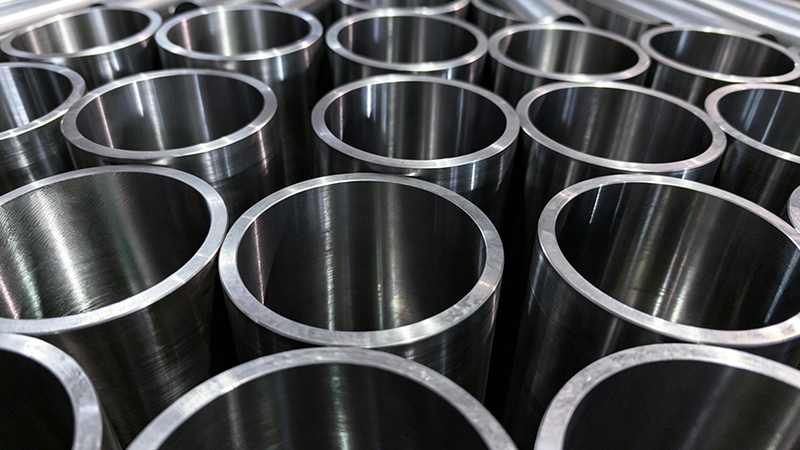
A tighter straightness or roundness tolerance on honed tube directly reduces seal wear variation and improves consistency of friction and leakage behavior across the stroke — genuinely valuable for high-cycle, precision-positioning, or tight-clearance applications where that consistency matters to the end function. Past a certain point specific to the application’s actual duty cycle and clearance design, tightening the tolerance further buys diminishing functional return while the cost curve keeps climbing steadily, because achieving each additional increment of precision requires proportionally more honing time, more frequent in-process measurement, and higher scrap risk on marginal pieces.
| Application Type | Typical Appropriate Tolerance Approach | Risk of Over-Specifying |
|---|---|---|
| High-cycle precision positioning cylinder | Tight tolerance justified by actual function | Low — tolerance matches real need |
| General industrial, moderate duty cycle | Mid-range tolerance usually sufficient | Moderate — easy to over-tighten by habit |
| Low-cycle, light-duty, non-critical application | Standard commercial tolerance adequate | High — tight tolerance buys no real benefit |
| Application with generous seal clearance design | Tolerance demand reduced by clearance itself | High if tolerance ignores clearance design |
Asking What the Seal Clearance Actually Tolerates
The honed tube tolerance doesn’t operate in isolation — it interacts directly with the seal design’s own clearance tolerance to determine actual sealing performance. A seal designed with generous radial clearance tolerance can comfortably accommodate a looser honed tube tolerance without any functional compromise, while a tight-clearance seal design genuinely needs a correspondingly tight tube tolerance to avoid uneven loading. Specifying a tight tube tolerance without first checking what the paired seal design actually requires is specifying in isolation, and it’s one of the most common sources of unnecessary cost in a design that otherwise has a perfectly reasonable overall tolerance budget.
The Conversation Worth Having With Your Supplier Before Finalizing a Drawing
A supplier who sees a tolerance specification tighter than what’s typical for a comparable application will often flag it during a quoting conversation, if asked directly rather than simply quoted against silently. Asking a supplier what tolerance level is standard for similar applications, and what cost difference exists between the specified tolerance and a looser but still functionally adequate alternative, gives you real pricing information to weigh against the actual performance benefit before the drawing gets locked in. A supplier who quotes silently against an over-tight spec without raising the question isn’t being dishonest — they’re simply quoting what was asked for, and the opportunity to catch unnecessary cost belongs to whoever initiates that conversation.
Why Pushing Back on an Inherited Tolerance Feels Riskier Than It Actually Is
The engineer who proposes loosening an inherited tolerance carries visible responsibility if anything ever goes wrong downstream, even years later and even if the looser tolerance had nothing to do with the actual failure. The engineer who simply carries forward the existing tight tolerance carries no such visible responsibility, which creates an asymmetric incentive toward over-specification that has nothing to do with actual engineering judgment. Breaking this pattern requires treating a tolerance re-evaluation as a documented engineering decision with its own supporting rationale — not a unilateral guess — so that loosening a tolerance is defensible with the same rigor as the original tightening was, rather than being an undocumented risk one person quietly absorbs alone.
Building the Rationale That Makes a Looser Tolerance Defensible
A defensible tolerance decision documents the actual duty cycle, the seal clearance design it pairs with, and the specific functional requirement the tolerance is meant to protect against — not just the number itself. This documentation does two things: it gives the current engineer backing to specify an appropriately looser tolerance without carrying undue personal risk, and it gives a future engineer reviewing the same drawing years from now the context needed to understand why that tolerance was chosen, preventing an unnecessary re-tightening the next time someone inherits the drawing without that context.
What to Do When You’re Genuinely Unsure Which Tolerance Is Right
When the appropriate tolerance for a new or unusual application genuinely isn’t clear from existing design guides or past experience, a conversation with your honed tube supplier’s technical team — describing the actual duty cycle, pressure range, and seal design rather than simply asking them to quote a number — often produces a more useful answer than guessing conservatively and carrying forward an unnecessarily tight spec. A supplier who regularly produces tube for a wide range of applications has practical experience with what tolerance level different duty cycles actually require, and that experience is worth drawing on directly rather than defaulting to the tightest tolerance available out of uncertainty.
A Real Example of What an Unnecessary Tolerance Actually Costs
An equipment manufacturer building a moderate-duty material handling cylinder had specified a straightness tolerance originally developed for a precision positioning application in an entirely different product line. When the supplier’s technical team asked directly what duty cycle and seal clearance the new application actually involved, it became clear the moderate-duty cylinder’s seal design already tolerated a meaningfully looser straightness specification without any functional compromise. Relaxing the tolerance to match the actual seal clearance design reduced the honing time per piece and cut the scrap rate on marginal pieces that previously required rework or rejection under the tighter spec. Across the production volume for that cylinder line, the cost difference was substantial enough to materially improve the overall program’s margin — not because the manufacturer compromised on quality, but because the original tolerance had never actually matched what the application needed in the first place.
Why This Decision Deserves Its Own Line Item in a Design Review
Tolerance specification often gets treated as a background detail finalized early and rarely revisited, buried inside a drawing rather than called out as its own explicit decision during a formal design review. Giving tolerance its own discussion point — alongside bore size, stroke length, and pressure rating as decisions that get actively reconsidered rather than passively inherited — creates a natural checkpoint where someone is specifically prompted to ask whether the specified tolerance still matches the application’s actual duty cycle and seal clearance, rather than assuming a tolerance that worked for a past design still fits by default. This single procedural change, treating tolerance as a decision rather than a default, is often enough on its own to catch the majority of unnecessary over-specification before it reaches a locked drawing and a final quote.
How Tolerance Interacts With Lead Time, Not Just Price
An unnecessarily tight honed tube tolerance doesn’t only add cost — it can also extend lead time, since tighter tolerances typically require more in-process measurement checkpoints and sometimes a slower honing feed rate to maintain consistency across the full length of the tube. For a program under schedule pressure, an over-specified tolerance that adds even a few days to the honing cycle can matter as much as the price difference, particularly when that lead time addition wasn’t anticipated because nobody questioned whether the tolerance was actually necessary for the application before it was locked into the drawing and sent out for quoting.
Revisiting Tolerance on Existing Designs, Not Just New Ones
The opportunity to question an over-tight tolerance isn’t limited to new designs. An existing product line with years of field history and no reported issues related to straightness or roundness is a strong candidate for a deliberate tolerance review, since real-world performance data now exists to support a more confident decision than existed when the original tolerance was first specified. A manufacturer willing to revisit a mature design’s tolerance specification, armed with actual field performance history rather than the original cautious guess, often finds meaningful cost reduction available on a design that was assumed to be already fully optimized simply because it had been in production for years without apparent issues.
How Much Risk Is Actually Removed by Loosening a Mature Design’s Tolerance
A legitimate concern when revisiting a mature design’s tolerance is whether loosening it reintroduces a risk that was deliberately engineered out years ago for a reason nobody currently on the team remembers. This is precisely why documentation matters as much as the technical analysis itself — if the original rationale for the tight tolerance can be traced back to an actual field failure or a specific functional requirement, that history should weigh heavily against loosening it regardless of how much cost savings might be available. If no such rationale can be found, and the tolerance appears to have simply been inherited from an unrelated application without ever being deliberately justified for this one, that absence of documented rationale is itself useful information supporting a confident case for revisiting it.
Why a Phased Approach Works Better Than Changing Every Drawing at Once
Attempting to re-evaluate tolerance specifications across an entire product catalog simultaneously tends to stall out from sheer scope, with no individual design ever getting the focused attention needed to make a confident, well-documented decision. A phased approach — starting with the highest-volume designs where the cost impact of any unnecessary tightness compounds across the most units, then working through lower-volume designs over time — produces faster, more concrete results and builds organizational confidence in the review process itself, making it easier to sustain as an ongoing practice rather than a one-time initiative that loses momentum after the first few drawings prove more complicated to resolve than expected.

Related Reading
- Same-Region or Overseas: Where Should an OEM’s Second Honed Tube Supplier Actually Sit?
- A Supplier Wants a Multi-Year Volume Commitment. The Discount Isn’t the Part That Matters.
- Honed Tube Wall Thickness and Pressure Rating: A Selection Guide
Want a second opinion on whether your current honed tube tolerance matches your actual application?
Contact EAST AI (eaihydraulic.com) Email: market@east-ai.com Phone: +86 13771568763 Address: Wuxi, Jiangsu, China.
Written by Alex, Production Engineer at EAST AI