
Every honed tube shipment arrives with a Mill Test Certificate, and most receiving teams treat it as binary: present equals compliant, absent equals problem. The actual information value of an MTC depends entirely on what it covers, how it was produced, and whether the document in front of you is genuinely linked to the specific material in the shipment — and on all three dimensions, a significant share of MTCs in circulation fall short of what buyers reasonably assume they’re getting.
This is not a theoretical concern. When a quality investigation traces a cylinder failure back to a specific honed tube shipment, the MTC is often the first document pulled. If it turns out to be a generic certificate not matched to the specific heat, a copy-paste from an earlier shipment, or a document covering the base steel but not the finished tube processing, the investigation hits a documentation dead-end that real traceability would have avoided.
Published: 2026-10-29 | Last Updated: 2026-10-29
The Difference Between a Base Steel MTC and a Finished Tube MTC
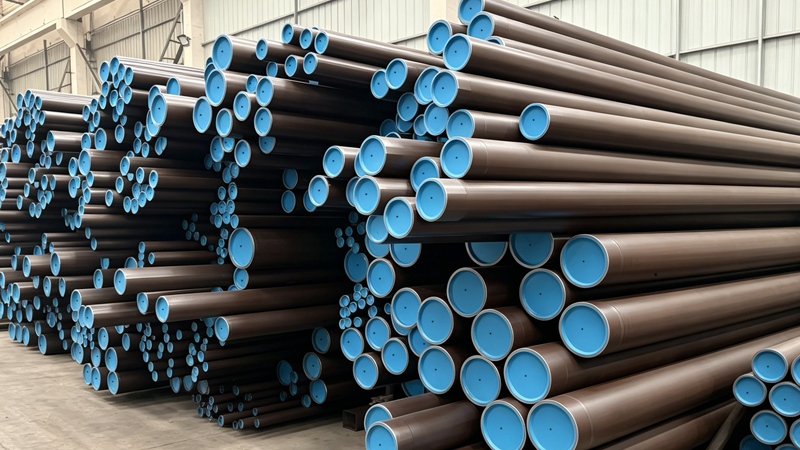
Honed tube production starts with steel tube — typically DOM (Drawn Over Mandrel) or cold-drawn seamless — and involves additional processing: honing, surface treatment, and dimensional finishing. A base steel MTC covers the chemistry and mechanical properties of the incoming steel tube before processing. A finished tube MTC, when one is issued, covers the properties of the tube as delivered to the buyer, after all processing.
When you receive an MTC with a honed tube shipment, determine whether it covers the base steel input or the finished tube, since a base steel MTC tells you nothing about whether the subsequent processing introduced any dimensional or surface issues — the document is technically legitimate but covers only part of the product you actually received.
Most buyers assume they’re receiving finished-tube documentation. Many are actually receiving base steel documentation reissued under the supplier’s letterhead. The distinction is not always obvious from the document itself, but asking the supplier directly — “does this MTC reflect testing on the finished, processed tube, or on the incoming base steel?” — produces a clear answer quickly.
Heat Number Matching: The Most Frequently Skipped Verification
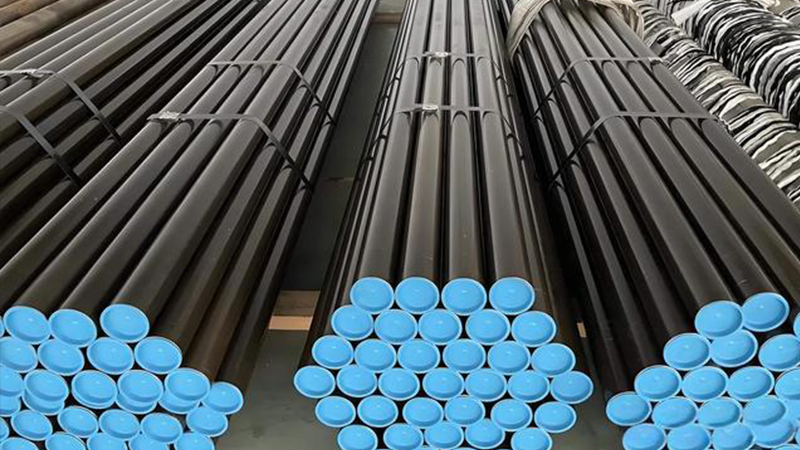
An MTC is only as useful as its connection to the specific material in the shipment. That connection runs through the heat number (or melt number) — the identifier that links a specific lot of steel to a specific set of test results. For the MTC to provide genuine traceability, the heat number on the certificate must match the heat number stamped or marked on the material itself, or documented on the packing list.
| Traceability Level | What It Provides | Verification Step |
|---|---|---|
| Genuine lot-specific MTC | Chemistry and properties for the exact material in your shipment | Check heat number on MTC against marking on material or packing list |
| Generic supplier MTC | Properties for “this grade” without lot-specific linkage | Ask for heat number; if supplier can’t provide, document is not lot-specific |
| Copied or reused MTC | Document from a prior shipment, reissued with updated dates | Check whether heat number and production dates are internally consistent |
| Third-party lab report | Independent verification of specific lot properties | Strongest form; check lab accreditation and sample identification |
At receiving inspection, record the heat number from the MTC and verify it against the material marking or packing list documentation rather than treating the MTC as self-validating — this step takes thirty seconds and is the difference between genuine traceability and a document that merely looks like traceability.
For manufacturers with quality systems requiring lot traceability, this single verification step is the most cost-effective quality control action available at incoming inspection.
What Chemistry Data Actually Tells You — and What It Misses
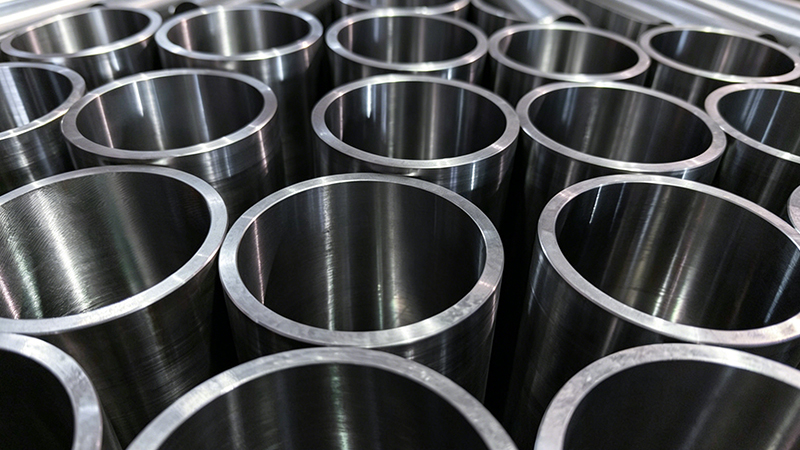
An MTC chemistry section typically reports carbon, manganese, silicon, phosphorus, and sulfur content, along with any alloying elements relevant to the specified grade. This data confirms that the steel fell within the compositional range for the stated grade at the time of casting. What it does not tell you:
- Whether the steel’s microstructure is appropriate for the specified application (hardness distribution, grain structure)
- Whether the material behaves as expected during the honing process (affects bore surface quality and dimensional stability)
- Whether processing after steel production introduced any issues (heat from cutting, residual stress from forming)
- Whether the actual mechanical properties — yield strength, tensile strength, elongation — were confirmed through physical testing or estimated from chemistry
Request that your supplier explicitly confirm whether the mechanical property values on the MTC reflect actual physical testing of the lot or are estimated from chemistry alone — grade chemistry and physically tested mechanical properties are not the same level of evidence, and some suppliers report one while buyers assume the other.
Many standard commercial MTCs report “typical” or “estimated” mechanical properties derived from chemistry rather than from tensile testing of the specific heat. This practice is common, disclosed (if you look for the notation), and technically within most commercial standards. But buyers evaluating material for pressure-bearing or safety-relevant applications should know whether they have physical test data or chemistry-estimated values.
The Dimension Inspection Data That’s Often Missing From the Package
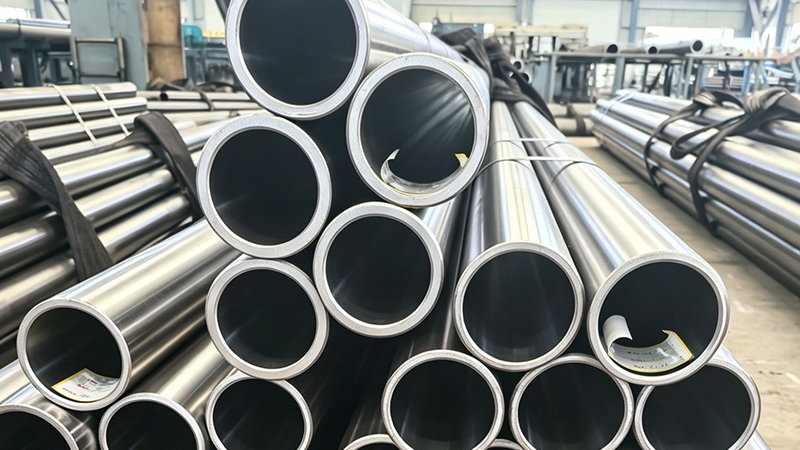
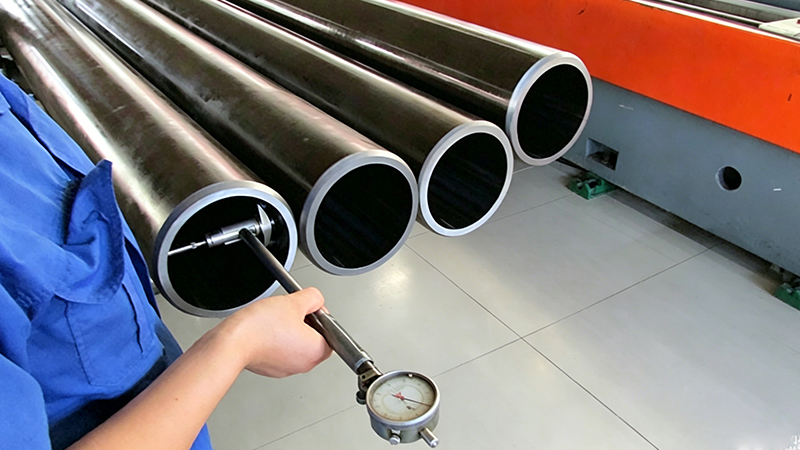
An MTC covers the material composition and (sometimes) mechanical properties of the base steel. It does not cover the dimensional characteristics of the finished honed tube — bore diameter, OD, wall thickness, roundness, straightness, or surface Ra value. These dimensions are documented on a separate inspection report (or dimensional certificate), which should accompany the MTC as a complete package.
| Document | What It Covers | Who Issues It |
|---|---|---|
| Mill Test Certificate | Steel chemistry, mechanical properties (base material) | Steel mill or processing supplier |
| Dimensional Inspection Report | Bore ID, OD, wall thickness, roundness, straightness | Honed tube processor |
| Surface Finish Report | Ra value, honing pattern description | Honed tube processor |
| Plating Report (if applicable) | Chrome or other coating thickness | Plating processor |
For quality-critical applications, require a complete documentation package — MTC plus dimensional inspection report plus surface finish confirmation — rather than accepting an MTC alone as sufficient evidence of specification compliance.
A supplier who provides only the MTC without dimensional inspection data is providing incomplete documentation, regardless of how clean the chemistry certificate looks. The dimensional inspection report is where the processing quality is actually documented.
When to Request Third-Party Verification
For large orders, first-time suppliers, or applications with significant safety consequences, third-party verification of key MTC parameters — particularly mechanical properties and dimensional characteristics — provides a level of assurance that no supplier-issued document can match. A supplier who objects to third-party inspection on a large order is raising a flag worth investigating.
Establish a policy for which order sizes and application categories trigger a third-party inspection requirement, and communicate it to suppliers at the RFQ stage rather than introducing it after a purchase order is placed — this removes negotiating friction and sets clear expectations before a supplier relationship is established.
Third-party inspection services are available in most major manufacturing regions and typically add a modest cost relative to the order value. For applications where a honed tube failure could generate significant warranty exposure or safety liability, that cost is straightforwardly justified. For routine commercial orders on a well-established supplier relationship, it’s often unnecessary overhead.
Building MTC Review Into Your Receiving Process
An MTC that arrives with a shipment and goes directly into a filing cabinet without review provides no quality protection — it’s documentation theater rather than quality assurance. The MTC’s value is realized only when it’s reviewed against the order specification and the material in the shipment, with any discrepancies flagged before the material enters production.
Designate a specific person or role responsible for MTC review at receiving, define the minimum checks they’re expected to perform (grade match, heat number verification, date plausibility), and document the outcome — not because most shipments will have problems, but because the shipments that do have problems need a documented review trail to support any subsequent quality action.
For manufacturers who use honed tube in pressure-bearing applications and maintain a formal quality management system, this receiving review is already required. For distributors who may not have the same formal QMS infrastructure, a lightweight version of the same process — grade check, heat number recording, date review — provides most of the protection with a fraction of the overhead.
Understanding what an MTC actually proves is one of those quality fundamentals that sounds obvious in principle but gets skipped in practice precisely because nothing goes wrong most of the time. When something does go wrong, the quality of your documentation determines whether you can resolve it quickly or spend weeks reconstructing a paper trail that should have been built at receiving. If you’d like to understand the specific documentation we provide with each honed tube shipment — including what’s standard and what’s available on request — our team at EAST AI is glad to walk through it: reach us at market@east-ai.com or +86 13771568763.
What We Offer
- Lot-specific MTC matched to the actual heat number for every shipment, with verification against material marking as standard practice
- Dimensional inspection report — bore ID, OD, wall thickness, roundness — issued per lot alongside the MTC as a complete documentation package
- Surface finish (Ra value) confirmation available on request for applications with specific bore surface requirements
- Third-party inspection coordination support for large orders or new customer qualification runs
How to Use MTC Data When Investigating a Field Quality Issue
When a cylinder failure triggers a quality investigation and the honed tube is a suspect, the MTC becomes the starting point for determining whether the base material contributed to the failure. A complete, lot-specific MTC package allows the investigation to quickly confirm or rule out material properties as a contributing factor — chemistry outside the specified range, mechanical properties below minimum, or dimensional data showing the tube was already near the tolerance boundary before it left the factory.
Before a quality issue arises, confirm that your MTC filing system links each stored certificate to the specific production order it covered — a certificate that can’t be matched to a specific shipment during an investigation is nearly as useless as no certificate at all. This linkage is a filing discipline issue as much as a documentation quality issue, and it applies to both the original receiving records and any certificates the supplier sends after the fact.
For distributors who may receive honed tube from multiple suppliers on the same order or over a short time window, maintaining clear separation between lot-specific documentation from each supplier — rather than filing all certificates for a given bore size together — makes the investigation trace significantly cleaner when a quality question eventually arises.
Related Reading
- How Much Does Switching Honed Tube Suppliers Actually Cost an Equipment Manufacturer, Beyond the Unit Price?
- How Should an OEM Decide Whether a Field Failure Is a Honed Tube Defect or an Installation Error?
- Honed Tube Products
Contact EAST AI (eaihydraulic.com) Email: market@east-ai.com Phone: +86 13771568763 Address: Wuxi, Jiangsu, China.
Written by Jeff, Founder of EAST AI